ARIZONA, RISEN
'Raising Arizona' turned 40 recently. This three-part examination of the movie's evolution starts at a city council meeting in Scottsdale.

By Cory Frye
Chapter One: We Begin
“You’re a flower, you are. Just a little desert flower.”
— H.I. “Hi” McDunnough to the future Mrs. Edwinna “Ed” McDunnough,
Raising Arizona script (revised first draft, Aug. 18, 1985)
The Scottsdale City Council met at 11 a.m. Monday, Dec. 30, 1985. Smack between Christmas and New Year’s.
Nine agenda items that morning. Nothing major. Attendees blew in and out in 20 minutes.
One matter involved acquiring property at 3701-3711 N. 75th Street from the Scottsdale Plumbing Company as part of the city’s municipal block plans. And, as a result of Resolution No. 2647, if you stopped at that address tomorrow, you’d be parked across from the Scottsdale Justice Center. The Young at Heart Bingo Club requested and received a license for games at the New Ventura Apartments. The R.G. Johnson Construction Company won the go-ahead to fix that troublesome dip and ditch lining on 84th Street north of Pinnacle Peak Road. Ambrosino’s Italian Gourmet Dining left the Kiva cleared once more to serve liquor.
But Item No. 4? We still talk about it. In fact, it’s an integral part of the state’s cultural history.
Carefree, come and gone
Opened in 1968, Carefree Studios sat two miles south of Carefree up Scottsdale Road, with its trio of 10,000-square-foot soundstages and a single Western street set. Foothills sprawled in the picturesque distance. Producer/director Richard Robinson’s To Hell You Preach was shot here in late 1971. So did The New Dick Van Dyke Show, when its namesake lived in Cave Creek. Then it got kicked back to Hollywood, where it quickly died. The Carefree lot didn’t fare much better.
State Farm Insurance Co. grabbed the foreclosed property in 1974. The name stayed. So did its buildings, though curious visitors were shooed away. There was little to see. Minimal life. Closed doors, locked. Production turned sporadic — commercials, myriad whathaveyous. The Scottsdale-based Oasis Productions planned to start Brother Monks with Harvey Korman and Tim Conway there in June 1981. Hardy Price of the Arizona Republic later reported that a looming director’s strike might move some of it to Durango, Mexico, instead. Turns out, however, Brother Monks may have filmed nowhere at all, as it doesn’t appear in either man’s filmography, or in that of its appointed director, Michael Preece.
Mostly, Carefree Studios lived up to its name, hosting benefits and other events. A place where movies were made. Once upon a time …
But in 1985, interest in the studio stirred when a film production company needed somewhere to land. The City of Scottsdale leaped into action, agreeing to lease Carefree for $61,200, then sublease it to this curious party for $65,700.
A cinematic flair
Whoever this was clearly spoke Deputy City Manager Richard “Dick” Bowers’ language. About two years earlier, Scottsdale Mayor Herb Drinkwater collared him into his office as Bowers strolled City Hall. Drinkwater wrestled a conundrum. A gaggle from L.A., making a picture called Just One of the Guys, needed settings for its gender-swap/PG-13 teen-romp plot. Within a day, Bowers finalized a deal to use the Scottsdale High School campus, shuttered in 1983 ($60,000 rent, as Drinkwater recalled).
Usually, the mayor reviewed such requests. He seemed to have been movie-mad himself, especially after reading about the wonders film did for local economies. “I got to thinking that it’s a neat, clean business,” he told the Republic’s Christia Gibbons in 1986. “It leaves tax dollars while creating no permanent environmental damage or traffic problems.”
But the experience got Bowers to thinking, too. Scottsdale, he felt, was in a perfect position to become some kind of Southwestern motion-picture epicenter. He subscribed to Variety and studied it so deeply that, like a real mover, he could yank any germane detail from the ether and toss it into conversation. Runaway productions, for instance. What are those? He could tell you: anything shot beyond California. And that loss cost the state $1.5 billion in 1984.
So, how much money could the industry pump through local blood?
“This is a whole new economy base that is recession-proof and not dependent on tourism,” he reasoned.
Of course, Arizona was never, in any way, foreign to film or television, going back to the genesis of each. Film Phoenix, opened in 1974, took care of its own backyard. Other cities and communities maintained offices, too, as did the state. Attractive climate and vistas made the whole realm ideal for Westerns (see: Old Tucson, Prescott, Monument Valley, and Sonoita), and versatile landscapes easily conveyed other locales. In 1977, Claude Lelouch shot his French-language Un autre homme, une autre chance (Another Man, Another Chance) in part around Tucson and Patagonia, drawing $250,000 to the state. Some 12 months later, William MacCallum, director of Arizona’s Motion Picture Development Program, calculated that the industry would spend $16 million statewide during the Me Decade’s last year, adding, “I don’t see it slowing down any.”
It was a prosperous period, overall. Barbra Streisand brought A Star Is Born to Phoenix, fortifying the Ramada Inn on East Van Buren Street with ever-present guards. Clint Eastwood sped a bus through the city’s Civic Plaza for The Gauntlet. As the ’80s began, George Lucas brought Return of the Jedi scenes to Yuma. MacCallum congratulated Flagstaff for hosting a smooth, successful shoot for Warner Bros.’ National Lampoon’s Vacation. “Our office can’t buy advertising that has as much impact as a happy production crew returning to Hollywood … has in selling Arizona to the motion picture industry,” he beamed in a September 1982 letter to both Mayor Paul Babbitt and that city’s Sun.
But the boomtimes tapered off. “Probably our best year was 1979,” MacCallum reflected, only weeks before the Vacation crew left, “when more than $20 million was spent by film people in Arizona. That slacked off to $16 million in ’80, $13 million in ’81, and we expect $8 or $9 million this year.”
Nevertheless, there were benefits.
“[The film companies] don’t pollute the air,” MacCallum told the L.A. Times’ Claudia Luther. “You don’t have to build schools, sidewalks, or sewer systems to accommodate them. They take advantage of what’s available. The only real residue is the money they’ve spent. And everybody has made a killing while they’re there.”
It all comes down to Scottsdale
Dick Bowers said pretty much the same thing before the Scottsdale council, using the upcoming Fiesta Bowl as a mathematical comparison. The Tempe sporting event could haul some $20 million into the area.
Then came the smaller story problem at hand. This slated production carried at least a $3 million budget, which meant money for the city. It also meant possible employment for about 65 locals, plus food allowances, room rentals, vehicle rentals, and other amenities over a potential four-month shoot. A beneficial win-win for everyone, financially and reputationally. It could very well produce dividends for years to come.
He received little pushback on his points. City attorney Bill Farrell advised that the signed leases weren’t yet available, but Mayor Drinkwater — who obviously supported the project — could be authorized to execute them. That was about the closest the morning came to “no.” Councilwoman Renee Wendell likened it to Horseman’s Park, then in development, as a revenue source, up to $200 million annually.
In the end, Resolution No. 2646 passed. It was unanimous, 7-0.
“Have a very happy New Year,” Drinkwater vowed as the meeting adjourned.
Amen. The movies were coming to Scottsdale in 1986, courtesy of Washington, D.C.’s Circle Films and a production company that in city materials called itself Raisin’ Arizona.
From Blood to simple
It’s hard to remember now when only unrepentant film geeks knew Joel and Ethan Coen.
The Minneapolis-minted brothers had taken separate educational paths but arrived at the same destiny. Joel studied film at New York University, making him the obvious director. Ethan dabbled in philosophy at Princeton, thus explaining his eventual role as producer. Both wrote, collaborating from their Manhattan apartment — Ethan’s fingers hovering above home row — on a script in the early ’80s.
It was a noirish thriller inspired more by Dashiell Hammett, James M. Cain, and Raymond Chandler novels than by their stylish adaptations, brushed with comedy, intentional or otherwise, while gushing with violence. They cribbed the title from Hammett’s Red Harvest (1929), inspired by Continental Op’s lament, “This damned burg’s getting me. If I don’t get away soon, I’ll be going blood-simple like the natives.” Blood Simple. Solid.
As writers, they let the evolving story’s twists creep up and shove them into darkness. “Our working strategy,” one or the other — or what the hell, both — told the Sunday News Journal’s Harry F. Themal (he gave up trying to determine where either began or ended), “was to paint ourselves into corners, and as we worked our way out, the audience would also be trying to figure out how to get out of situations. We wanted it to be unexpected but not contrived.”
They set Blood Simple in Texas, Joel calling the state a “logical milieu for a passion murder story.” Then they spent roughly a year securing the $1.5 million to make it themselves — mostly from some 60 investors, primarily from Minneapolis — and filmed it over eight weeks in Austin and Hutto in late 1982. Another year passed as they edited the work and searched for distribution, which itself took some time, as the film seemed too scattered (what is it: an art film? A thriller? Horror, perhaps? How do we sell this?) for possible suitors.
Not until Blood Simple hit the festival circuit did its fortunes reverse. The USA Film Festival in Dallas positively radiated in its wake. Executive program director Sam Grogg declared it “the discovery” of the 1984 event, while Austin American-Statesman writer Patrick Taggart managed to turn “utterly ghastly” and “rambunctiously funny” into an unqualified rave. The Globe and Mail’s Jay Scott caught it at Toronto’s Festival of Festivals and contrasted “nasty” with “deliriously arty” and “magnificently unpredictable.” Its momentum carried it to the New York Film Festival that November, at which point they landed Circle Films to distribute it to theaters across the country.
So, what did these wunderkinds plan for an encore? They had many ideas in various stages of development. They’d worked with The Evil Dead’s Sam Raimi on a script called The XYZ Murders, which would be released on videocassette under the Raimi aegis in 1985 as Crimewave. Another, with a 1950s-set plot, required a considerable budget, one perhaps too grand for Circle Films. Therefore, The Hudsucker Proxy sat tight. A “low-budget suspense mystery” was also in the cards.
But Film No. 2 would be none of those. It was entirely new, in fact. They wrote the script over four months that New York spring/summer of ’85, so it truly came from nothing but a desire to ride a wilder beat.
“Essentially,” Ethan recollected years later, “we wanted to make something completely different. We didn’t know what, but we wanted it to be funny, with a quicker rhythm.”
So they stomped a comic mishmash of Preston Sturges, Wile E. Coyote slaking his ongoing roadrunner thirst, all-stripes slapstick going back to the silents, William Faulkner’s dark Southern absurdities,,,,, and even Flannery O’Connor’s wicked Gothic sardonicism.
As they wrote, the first face they envisioned belonged to Holly Hunter, an actress who had moved to New York with Frances McDormand in the early 1980s. The latter co-starred in Blood Simple and eventually married Joel Coen, while the former, who’d first appeared onscreen in 1981’s The Burning and got erased from 1984’s Swing Shift — well, the brothers had wanted to use her for their debut, too, but couldn’t.
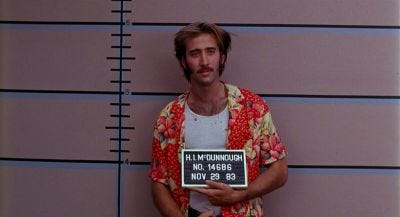
Nevertheless, her disposition remained foremost in their minds as they launched this undertaking in April 1985. They imagined her in a police uniform, Georgian twang barking authoritatively at prisoners. Turn to the RIGHT! Turn to the RIGHT! That cadence spurred the Coens forward into a story involving a kidnapped baby, lawlessness, and conscious attempts at redemption fueled by a semi-hapless protagonist they named H.I. “Hi” McDunnough, who, as his and his creators’ first act, told his story as quickly as it came to them.
Hi was a repeat criminal attempting a straight line, like any good American during Reaganomics’ red-blooded roll. Hell, he wasn’t a bad guy. Deep in his soul, he wanted to do right, even in his vocation as a convenience-store holdup man. The firearm in his pocket was empty, so no one he encountered was ever in danger. (“It ain’t armed robbery if the gun ain’t loaded,” he’d reason, though that ain’t close to true.) Despite his outcomes, the man meant well.
To make good on his intentions, upon his latest release, Hi married Edwinna, a policewoman. The law itself. Who could beat that? (Turn to the RIGHT! Turn to the RIGHT!) Then he wanted a family. Unfortunately, science denied him, as did his past, which everyone neatly buttoned into a single word, “recidivism.” So he defied laws both natural and mortal by plucking a newborn from a patch of quintuplets belonging to unpainted-furniture magnates Nathan and Florence Arizona. They were rich, had it all, while he and Ed were dirt-poor trailer trawlers with zip. That Hi made off with Nathan, Jr., the namesake son, was kismet. Class-struggle poetry.
“We were worried about that a little bit,” Joel said of the story spurting from a comic vein. “But we thought that as long as it was clear there was never any physical threat to the baby, and that the motives of everybody involved were pure, that even though it was kind of a taboo subject — kidnapping is not something you’d ordinarily joke about — that we would be able to put it over.”
Top it with the enticements of Hi’s old ways in the personages of escaped jailmates Gale and Evelle Snoates — brothers themselves, much like the diapered Arizonas; the swinging, suburban perversions of Glen and Dot and their rabble-headed progeny; and a predatorial id in chopper-topped bounty hunter Leonard Smalls. Unkillable, almost, and, uh, well, who the hell is he? A third party commissioned to get the kid back? Hi’s worse nature? Nefariousness manifested? An unintended future?
“A wildy,” Joel explained to The Morning Call, helpfully adding, “There’s an old Mack Sennett studio that used to bring someone in from an insane asylum to sit in on story conferences and blurt things. They called them wildies. If it sounded good to the writers, they’d write it into the script. We make up our own wildies.”
In any case, that’s a multilayered movie.
An added accouterment: the menagerie’s shared elocution, a mix of Biblical-adjacent pronouncements, back-porch simplicity, and literary rhythms shoved past Southern-fried — deep Southern-fried — tongues. It’s a deliberate stylistic choice, exacting in the script. Page 4, for instance, lists a specific mispronunciation of the word “fiancé”: Ed is to utter, “My fai-ants left me.” To which Hi replies, as written, “That sumbitch.” Though he wore mugshot boards like a favorite necklace, he was a good man, couldn’t bear to see her cry. For the rest of time, he’d quest to keep her happy.
Raising Arizona tracks that quest. The title works because its subject is a baby, a baby named Nathan Arizona, Jr., probable heir apparent to his father, Nathan Arizona, who himself was born Nathan Huffhines, which looked terrible on a business sign. “Would you,” he asks a police detective investigating his boy’s disappearance, “buy your furniture from a store called Unpainted Huffhines?”
But why Arizona? (Would anyone pay money to see Raising Huffhines?) Little past the scenery screamed it; the real Arizona seemed to backdrop a mythical one that didn’t exist, couldn’t exist, one that later became a bone of contention. Inspirations Faulkner and O’Connor hailed from the American South, not the Southwest: Mississippi and Georgia, to be exact. Raising’s characters all chaw a drawling pentameter no native Arizonan actually possessed. Overall, the story could have taken place anywhere.
There are a few possible reasons, none really plot-related. One: The price tag was agreeable, and the state was welcoming. Two: The Coens would film on location from late winter to early spring 1986 in reliably warm weather. (In his defense, Joel may have been kidding when he suggested that.) And three: Arizona felt great slammed against Raising, two syllables followed by three, a double-z sound zipped through both words.
As the brothers prepared to bring their vision to the Valley, Dick Bowers regaled the Scottsdale City Council with his. “We look forward to the film industry becoming a fairly significant player in the city’s economy,” he said.
Raising Arizona was on its way to wind through Scottsdale, Phoenix, and Apache Junction, a sumbitch for the ages. But what kinda sumbitch would it be?
Special thanks to the American Film Institute; Arizona Film Commission; Arizona Daily Sun; Arizona Republic; Phil Bradstock, Film Phoenix; Peter Catalanotte and Monica Lopez Guzman, Film Tucson; William Hemstrom, Oregon State University (Jon Lewis, academic advisor); The Hollywood Reporter; KD Forgia, Arizona Historical Society; Rhonda Johnston; Debra Knoblauch; TJ Kuhn; Tom Kuhn; Los Angeles Times; Danny MacCallum; Phoenix New Times; the City of Scottsdale; Linette Shorr; Julie Asch Smith; and Zia Records (Phoenix).
About Cory Frye:
Cory Frye is a Society of Professional Journalists and Oregon Newspaper Publishers Association award-winning writer and editor whose work since 1991 has appeared, variously, in the Oregonian (Portland, OR), the Albany Democrat-Herald (Albany, OR), Corvallis Gazette-Times (Corvallis, OR), Maggot Brain, Under the Radar, Hit List, Yahoo! Music, and the Rock & Roll Hall of Fame. From 2000 to 2007, he was a writer, researcher, and editor for the Rhino Entertainment record label in Los Angeles, where he even co-produced a pair of releases: the deliriously slaughtered Whatever: The ’90s Pop & Culture Box (2005) and the better-acclaimed Afghan Whigs career compendium, Unbreakable: A Retrospective (2007). In 2015, he published his first book, Murder in Linn County, Oregon: The True Story of the Legendary Plainview Killings (Arcadia Publishing/The History Press). His second, an in-depth biography of the Rowan & Martin comedy team, is planned for 2027.